Why landlords hold large deposits: a Dublin renter's guide
26 June 2026
10 min read
Discover why landlords hold large deposits in Dublin. Learn your rights and gain confidence as a renter in protecting your finances.
A security deposit is a sum of money a landlord holds to protect their financial interests when letting a property to tenants. If you have ever handed over a month or two of rent before you have even unpacked a single box, you have probably wondered why landlords hold large deposits and whether the amount is actually justified. The short answer is that deposits cover real, recurring costs: cleaning, damage repairs, unpaid rent, and redecoration. Understanding the logic behind landlord deposit policies, and your rights within them, puts you in a much stronger position as a renter in Dublin.
Why landlords hold large deposits
A security deposit is not simply a gesture of good faith. It is a financial buffer that landlords rely on to cover costs that arise when a tenancy ends. Landlords cannot always predict how a tenant will treat a property, and the costs of putting things right can be significant. A professional clean alone can run to several hundred euros in Dublin.
The deposit functions as pre-authorised access to funds. Rather than chasing a former tenant through the courts for unpaid rent or damage costs, a landlord can draw on the deposit directly. That makes it a low-friction financial tool, which is precisely why landlords value it so highly.
Deposits also reflect the reality that rental properties are business assets. Landlords carry mortgage repayments, insurance, maintenance obligations, and tax liabilities. A property left in poor condition after a tenancy creates an immediate cash-flow problem. The deposit exists to absorb that shock without the landlord having to fund repairs out of pocket while the property sits empty.
What costs do landlord deposits actually cover?
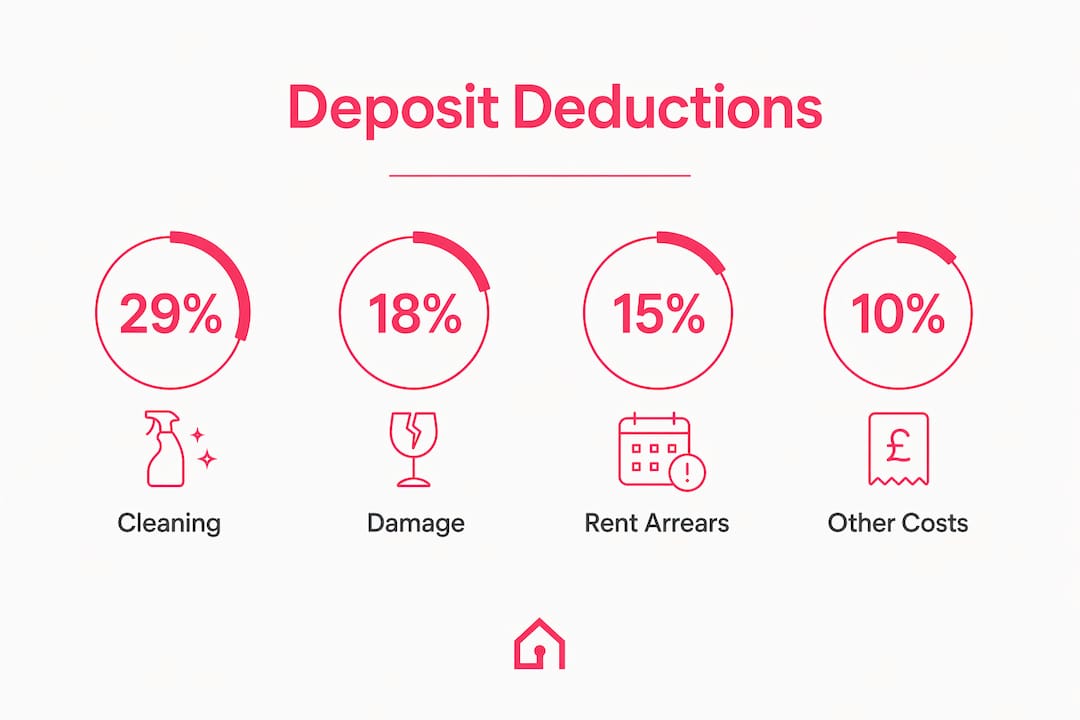
The reasons for tenant deposits are more varied than most renters expect. Cleaning is the single largest cause of deposit deductions. Cleaning claims rose from 24.57% of all deductions in 2021 to 29.38% in 2025. That means nearly one in three deposit disputes involves a property that was not returned in a clean condition.
Beyond cleaning, the breakdown of common deduction reasons looks like this:
Related Topics
#landlord rental security#landlord deposit policies#tenant deposit regulations#security deposit amount#how landlords assess deposits#why landlords hold large deposits#reasons for tenant deposits#purpose of security deposits#risks for landlords#why deposits are required#landlord financial protection#large deposits explanation
Related Articles
Reason for deduction
Share of claims (2025)
Cleaning
29.38%
Damage repairs
18.42%
Rent arrears
16.45%
Redecoration
10.88%
Damage repairs account for 18.42% of deductions, covering everything from broken fixtures to stained carpets. Rent arrears represent 16.45%, which reflects situations where tenants leave owing rent for their final weeks or months. Redecoration claims at 10.88% typically arise when tenants have painted walls without permission or caused scuffs and marks beyond normal wear and tear.
These figures matter for you as a renter because they show what landlords are genuinely worried about. Landlords are not holding deposits out of mistrust alone. They are protecting against costs that, based on real data, occur regularly across the rental market.
Pro Tip:Keep a written record of any pre-existing damage when you move in. A quick video walkthrough on your first day, shared with your landlord by email, creates a clear timestamp that protects you against unfair claims later.
How are deposit amounts regulated in the UK and Ireland?
Landlord deposit policies do not operate in a legal vacuum. Both the UK and Ireland have rules that cap how much a landlord can demand and how that money must be held.
In the UK, the rules under the Tenant Fees Act are clear:
For properties with an annual rent above £50,000, the cap rises to six weeks' rent.
Holding deposits, which are paid to reserve a property before signing, are capped at one week's rent.
A holding deposit must be refunded within seven days if the landlord decides not to proceed, unless the tenant is at fault.
In Ireland, the Residential Tenancies Act governs deposit rules. Irish law limits deposits to one month's rent, which means a landlord cannot legally demand two months upfront as a deposit, regardless of how competitive the Dublin market feels. If you are asked for more than one month's rent as a security deposit, that request falls outside what the law permits.
Beyond the amount, landlords carry a legal duty regarding how deposits are held. Security deposits must be held in trust, kept separate from a landlord's personal or business funds. Mixing tenant deposits with a landlord's own money is a legal violation in many jurisdictions. It can also forfeit the landlord's right to make deductions. Fiduciary responsibility requires landlords to treat your deposit as money that belongs to you until a legitimate claim is made against it.
Understanding your rental rights in Ireland is the clearest way to know whether what a landlord is asking for is lawful.
Why do landlords view deposits as a financial tool, not just protection?
This is where the picture becomes more nuanced. Security deposits are not neutral funds. Landlords treat them as a business resource that reduces financial risk and, in some cases, offsets routine maintenance costs.
The psychology behind this is straightforward. When money is already in hand, the barrier to spending it feels lower. A landlord who has your deposit sitting in an account faces less friction when deciding whether to charge for a professional clean than a landlord who would need to invoice you separately and chase payment. Withholding a deposit is financially more efficient than pursuing a former tenant through legal channels for the same amount.
"Deposits act as immediate liquidity for landlords, with low psychological barriers to spending for deductions. That dynamic shapes withholding behaviour in ways that go beyond simple damage protection."
This does not mean every landlord acts in bad faith. Most deductions are legitimate. But understanding that deposits carry this financial incentive helps you see why documentation and clear communication matter so much. A landlord who knows you have thorough move-in evidence is less likely to make a speculative claim.
Pro Tip:Ask your landlord for an itemised list of any deductions within the timeframe required by law. In Ireland, landlords must return your deposit or provide written reasons for any deductions promptly after the tenancy ends. If they cannot itemise the claim, the deduction may not be enforceable.
How can you protect your deposit and challenge unfair deductions?
The good news is that tenants have real tools to protect themselves. The key is preparation before and during the tenancy, not just at the end.
Complete a joint condition report on move-in day. Walk through the property with your landlord or their agent and note every existing mark, stain, or fault. Both parties should sign the report. This single step removes most of the ambiguity that leads to disputes.
Take dated photographic evidence.Photographic documentation of property condition at move-in and move-out is the most reliable way to challenge unfair deductions. Photograph every room, every appliance, and any pre-existing damage. Store the images somewhere with a clear date stamp.
Understand what counts as fair wear and tear. Normal use of a property over time is not something a landlord can charge you for. A carpet that has faded after three years of normal use is fair wear and tear. A carpet stained by a spill is not. Knowing the difference helps you assess whether a deduction is reasonable.
Request itemised deduction statements. Landlords failing to provide proper documentation risk forfeiting their right to withhold portions of your deposit. If a landlord cannot explain exactly what each deduction covers, challenge it in writing.
Use dispute resolution services. The Deposit Protection Service offers a free dispute resolution service to settle disagreements fairly. Fewer than 5% of protected deposits end up in formal disputes, which shows that most issues are resolved before reaching that stage. In Ireland, the Residential Tenancies Board provides a similar adjudication process for tenants and landlords who cannot agree.
For practical guidance on recovering your money, the Hauzed blog covers how to get your deposit returned in Ireland step by step.
Key takeaways
Landlords hold large deposits primarily as financial protection against cleaning costs, damage, unpaid rent, and redecoration, all of which are governed by legal caps and fiduciary duties that tenants can use to their advantage.
Point
Details
Cleaning is the top claim
Cleaning accounts for 29.38% of deposit deductions, making it the most common reason landlords withhold funds.
Legal caps apply in Ireland
Irish law limits deposits to one month's rent, so any demand above that amount is not lawful.
Deposits must be held separately
Landlords are legally required to keep your deposit apart from their own funds, and mixing them can void their right to deduct.
Documentation is your strongest defence
A signed condition report and dated photographs at move-in dramatically reduce the risk of unfair deductions.
Free dispute resolution exists
The Residential Tenancies Board in Ireland and the Deposit Protection Service in the UK offer free adjudication for deposit disagreements.
A frank view on the deposit dynamic
From where Hauzed sits, watching thousands of rental interactions play out in Dublin and across Ireland, the deposit system is neither purely fair nor purely exploitative. It reflects a genuine tension between two reasonable positions.
Landlords carry real financial risk. A property left in poor condition can cost thousands of euros to restore, and the legal process for recovering that money from a former tenant is slow and expensive. Deposits exist because that risk is real, not imagined.
At the same time, tenants in Dublin face a market where deposits represent a significant upfront financial burden. Handing over one month's deposit on top of first month's rent in a city with high average rents is a serious commitment. When that money is withheld unfairly, the impact is not abstract.
What Hauzed believes, based on what actually works, is that transparency solves most of this. Landlords who communicate clearly about their expectations, provide condition reports, and itemise any deductions rarely end up in disputes. Tenants who document everything, ask questions upfront, and understand their rights rarely lose deposits they should not lose. The conflict usually happens in the gap between what was agreed and what was documented. Closing that gap, before the tenancy starts, is the most practical thing either side can do.
Understanding what to look for in a rental agreement before you sign is one of the best ways to avoid that gap entirely.
— Hauzed
Renting safely in Dublin with Hauzed
Deposits are just one part of a rental process that can feel complicated and high-stakes, especially in a competitive market like Dublin.
Hauzed is a trust-first rental marketplace built for Ireland. Tenants can search verified listings, build a stronger rental profile, and connect with landlords through a platform designed to reduce scams, ghosting, and the chaos of anonymous rental channels. When both sides of a tenancy start with verified identities and clear communication, the whole process, including deposit handling, tends to go more smoothly. Browse verified rentals in Dublin and take the first step towards a safer, more transparent tenancy.
FAQ
What is the maximum deposit a landlord can charge in Ireland?
Irish law limits security deposits to one month's rent. Any landlord requesting more than this amount is acting outside the legal framework set by the Residential Tenancies Act.
Why do landlords hold large deposits instead of smaller ones?
Landlords hold deposits sized to cover realistic costs such as professional cleaning, damage repairs, and rent arrears. Cleaning alone accounts for nearly 30% of all deposit deductions, which justifies holding a meaningful sum upfront.
What happens if a landlord does not return my deposit?
You can raise a dispute with the Residential Tenancies Board in Ireland, which offers a free adjudication service. A landlord who cannot provide itemised reasons for withholding your deposit may be required to return it in full.
Can a landlord deduct for normal wear and tear?
No. Landlords cannot legally deduct for fair wear and tear, which covers gradual deterioration from normal use over time. Deductions must relate to damage or costs beyond what ordinary use would cause.
What is a holding deposit and is it refundable?
A holding deposit is a smaller sum paid to reserve a property before signing a lease. In the UK it is capped at one week's rent and must be refunded within seven days if the landlord decides not to proceed, provided the tenant is not at fault. Irish rules on holding deposits should be confirmed directly with the landlord or agent before payment.