Learn how to identify fake rental listings in Ireland. Protect yourself from scams and secure your ideal home safely with these essential tips.
Fake rental listings are fraudulent property advertisements designed to steal money or personal information from renters before they ever set foot in a home. In Ireland, where housing demand consistently outpaces supply, scammers exploit that pressure to target tenants who feel they must act fast. Over 65,000 rental scams have been reported since 2020, with losses exceeding $65 million, and young adults aged 18–29 are three times more likely to be targeted than other age groups. Knowing how to identify fake rental listings is not optional in this market. It is a practical skill that protects your money, your time, and your peace of mind.
What are the red flags of a fake rental listing?
Fraudulent listings share recognisable patterns. Once you know what to look for, most scams become much easier to spot before any money changes hands.
The clearest warning signs include:
Price well below market rate. A listing priced 30% or more below comparable properties in the same area is a primary indicator of fraud. Scammers use artificially low rents to generate fast, emotional responses from renters who fear missing out.
Vague or missing address details. Legitimate landlords and agents provide a full address. A listing that only names a general area, or refuses to confirm the exact location before payment, is a serious concern.
Pressure to decide immediately. Scammers manufacture urgency by claiming multiple applicants are interested or that the property will be gone within hours. This tactic is designed to stop you from thinking clearly or doing any checks.
Requests for unusual payment methods. Any request to pay a deposit via wire transfer, cryptocurrency, or gift card is a definitive scam signal. These methods are irreversible, which is precisely why fraudsters prefer them.
Generic or stolen photos. Images that look too polished, show no personal touches, or appear on multiple listings with different addresses are a strong warning sign.
Poor spelling and grammar. Listings with repeated errors, awkward phrasing, or inconsistent formatting often originate from overseas scam operations.
Refusal to meet in person or arrange a live video tour. Any landlord who cannot or will not show you the property before you pay is not a landlord you should trust.
Pro Tip:Copy the listing description into a search engine. Scammers frequently reuse the same text across multiple platforms. If the same paragraph appears under a different address or price, you have found a duplicate scam listing.
How do you verify a rental listing, property, and landlord?
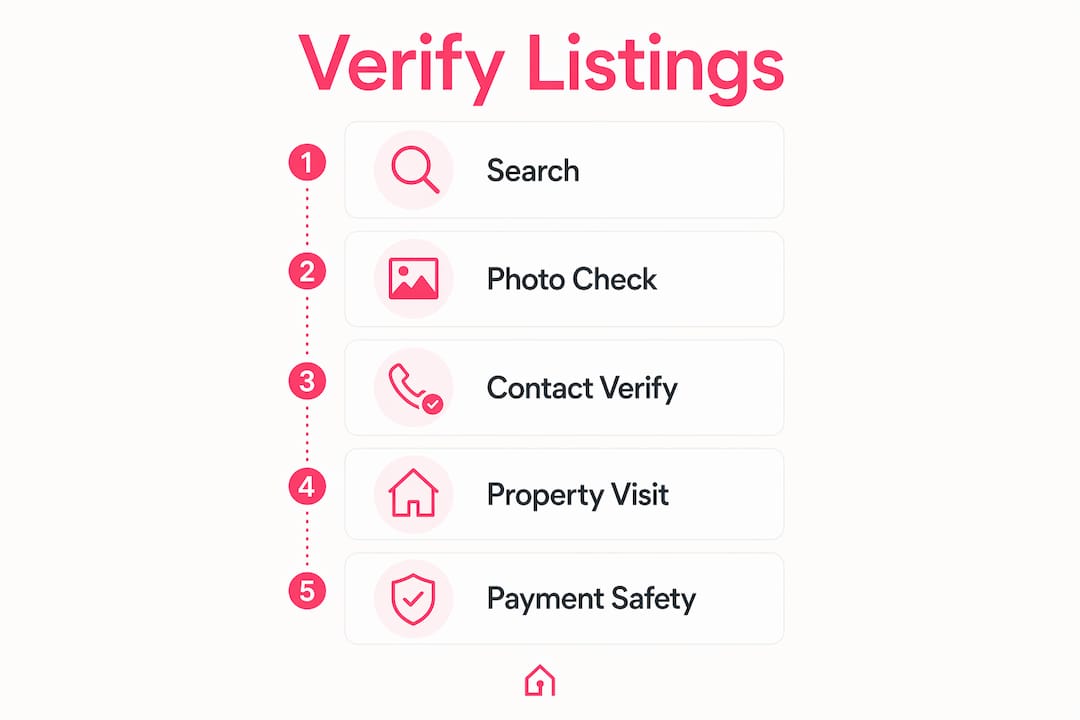
Verification is a sequential process. Clearing one check does not clear the others, because scammers can control one aspect of a listing while fabricating everything else. Use all three steps below before paying anything or signing any document.
Verify the listing itself. Search for the same property on at least three reputable rental platforms. If the listing appears only on one channel, particularly an informal social media group, treat that as a warning sign. Cross-referencing prices against similar properties in the same area also helps you judge whether the rent is realistic.
Verify the property. Arrange a physical viewing or, if distance makes that difficult, request a live video tour where the person walks through the property in real time. Be aware that scammers sometimes control access via lockbox codes without having any legal right to rent the property. A physical visit confirms the property exists. It does not automatically confirm the person showing it has authority to rent it.
Verify the landlord or agent. Ask for the landlord's full name and confirm it against the Property Registration Authority of Ireland records. If the listing comes from an agency, look up the agency independently and call the number on their official website, not the number in the listing. Never rely solely on contact details provided within the advertisement itself.
The table below summarises what each verification step confirms and what it does not.
Verification step
What it confirms
What it does not confirm
Cross-check listing on multiple platforms
Listing exists in more than one place
That the contact details are genuine
Physical or live video viewing
Property exists and matches photos
That the person showing it has legal authority
Landlord identity via official records
Name matches registered ownership
That the person contacting you is that owner
Pro Tip:Run the listing photos through Google Images or TinEye. If the same images appear on a property in another country or under a different address, the listing is fraudulent. Note that AI-generated photos will not appear in reverse image searches, so also look for unnatural lighting, distorted door frames, or warped architecture as signs of manipulation.
How do fake rental listings work and why are they convincing?
Understanding how scammers operate makes their tactics far less effective against you. Rental fraud generally takes one of two forms.
The first is a hijacked listing. A scammer copies a genuine, active property advertisement, replaces the contact details with their own, and republishes it at a lower price on a different platform. The photos are real, the address is real, and the description is accurate. That is exactly what makes it convincing. You are essentially responding to a real property being advertised by someone with no connection to it.
The second is a fully fabricated listing. The property either does not exist or is not available to rent. Photos are either stolen from estate agent websites or, increasingly, generated with AI tools. AI-generated images represent a newer evolution in rental fraud, because they produce no reverse image search results, removing one of the most common detection methods.
Scammers also rely on a set of well-worn scripts. The most common is the "out of town" excuse.
"Scammers frequently claim to be deployed military personnel, overseas workers, or missionaries who cannot meet in person. They offer to post keys after receiving a deposit. This is a classic ploy documented by consumer protection authorities, designed specifically to prevent face-to-face verification."
Urgency is a manufactured tactic, not a reflection of genuine demand. When a "landlord" tells you that three other people are viewing tomorrow and you must pay a holding deposit today, that pressure is deliberate. It is designed to make you skip the checks that would expose the fraud.
The payment method request is the final trap. Once money is sent via wire transfer or cryptocurrency, recovery is nearly impossible. That is not a technical limitation. It is the reason scammers insist on those methods.
What should you do if you suspect or fall victim to a rental scam?
Speed matters. The faster you act, the better your chances of limiting the damage.
Stop all communication with the scammer. Do not delete any messages, emails, or call logs. Every piece of correspondence is potential evidence.
Document everything immediately. Take screenshots of the listing, all messages, payment confirmations, and any profile or contact details the scammer used. Record exact communication times and note the platform where you encountered the listing.
Contact your bank or card provider without delay. If you paid by bank transfer, call your bank the same day. For credit card payments, you generally have up to 60 days to raise a dispute. The sooner you call, the more options your bank has.
Report to An Garda Síochána. File a report at your local Garda station and ask for a reference number. This is required for any formal fraud investigation in Ireland.
Report the listing to the platform. Whether the scam appeared on a social media marketplace or a rental website, use the platform's reporting tool to flag it. This helps protect other renters searching for a home.
Seek support if needed. The Citizens Information Board in Ireland provides free guidance on tenant rights and next steps after fraud. If you got scammed in Dublin, there are specific local steps worth following immediately.
Callout: 50% of all rental scams currently originate on Facebook Marketplace. If you found a listing through a social media channel, treat every subsequent step with heightened scrutiny.
Key takeaways
Fake rental listings are identifiable before you lose any money, provided you verify the listing, the property, and the landlord independently and in sequence.
Point
Details
Price is the first signal
A rent priced 30% or more below market rate is the clearest early warning sign of fraud.
Verification has three layers
Check the listing, the property, and the landlord separately. Passing one check does not mean the others are safe.
Urgency is a tactic, not a fact
Pressure to pay immediately is manufactured. Legitimate landlords allow reasonable time for due diligence.
Irreversible payments mean no recovery
Wire transfers and cryptocurrency cannot be reversed. Never use these methods for a rental deposit.
Document everything post-scam
Screenshots, timestamps, and scammer contact details maximise your chances of recovery and assist Garda investigations.
Hauzed's view: the mistake most renters make
The most common mistake I see renters make is treating speed as a virtue. Ireland's rental market is competitive, and that pressure is real. But the urgency you feel when you find a listing that looks perfect is exactly what scammers count on.
The renters who avoid fraud are not necessarily more experienced. They are the ones who pause for 24 hours before paying anything. They visit the property. They search the landlord's name. They check whether the photos appear elsewhere online. None of those steps take more than an hour combined. That hour is the difference between a safe tenancy and a lost deposit.
There is also a subtler mistake worth naming. Many renters assume that because a listing appears on a well-known platform, it has been vetted. It has not. Most listing portals allow anyone to post. The platform's brand does not transfer to the individual listing. You are still responsible for your own verification.
The good news is that scammers are not particularly creative. The same patterns appear repeatedly: the too-low price, the out-of-town landlord, the request for a wire transfer, the refusal to meet. Once you have seen those patterns once, they become obvious. Share what you know with friends and family who are also searching. Community awareness is one of the most effective defences against rental fraud in Ireland.
— Hauzed
Safer renting starts with a verified marketplace
Scam listings thrive in anonymous, unstructured channels. The antidote is a rental process where both sides are real and visible before any conversation begins.
Hauzed is a trust-first rental marketplace built for Ireland, starting with Dublin. Tenants can search verified rental listings and build a complete rental profile, including identity verification, to stand out to landlords with confidence. Landlords and agents receive verified tenant interest through structured workflows, reducing the noise of anonymous messages. Every interaction on Hauzed happens between real, identified participants. That structure does not eliminate all risk, but it removes the anonymity that makes rental fraud possible in the first place. Browse safe rentals in Ireland and see how a verified marketplace changes the experience.
FAQ
What makes a rental listing fake?
A fake rental listing is a fraudulent advertisement that misrepresents a property to extract money or personal information from renters. Common signs include pricing well below market rate, refusal to meet in person, and requests for payment via wire transfer or cryptocurrency.
How do I spot fake rentals on social media?
Check whether the listing appears on other platforms at a different price or with different contact details. Be especially cautious on Facebook Marketplace, where half of all rental scams currently originate.
Can I recover money lost to a rental scam?
Recovery depends on the payment method and how quickly you act. Contact your bank immediately, as credit card disputes are possible within 60 days. Wire transfers and cryptocurrency payments are generally unrecoverable, which is why avoiding those methods is critical.
How do I report fraudulent rental listings in Ireland?
Report the scam to An Garda Síochána at your local station and flag the listing directly on the platform where it appeared. Keep all screenshots and communication records, as these support any formal investigation.
What are the signs of a legitimate rental listing?
A legitimate listing includes a full property address, realistic pricing for the area, verifiable landlord or agent identity, and a willingness to arrange an in-person or live video viewing before any payment is requested.