Discover how Irish landlord-tenant law works in 2026. Learn about key reforms, security of tenure, and your rights as a tenant or landlord.
Irish landlord-tenant law defines the legal rights and duties of both landlords and tenants, providing statutory security of tenure, regulated rent increases, and clear grounds for ending a tenancy. The Residential Tenancies Board (RTB) oversees this framework and handles disputes when things go wrong. The Residential Tenancies Miscellaneous Provisions Act 2026 introduced the most significant changes in years, replacing the older Part 4 tenancy model with a new Tenancy of Minimum Duration (TMD) of six years. If you rent in Ireland, or you let a property here, understanding how Irish landlord-tenant law works is no longer optional. The 2026 reforms affect everything from how long you can stay in a home to how a landlord must notify you before ending your tenancy.
How Irish landlord-tenant law defines security of tenure
Security of tenure is the legal right of a tenant to remain in a rented property without facing arbitrary eviction. Under Irish law, tenants gain this right after six months of continuous occupation, provided no valid notice of termination has been served during that period. This is a foundational protection. It means a landlord cannot simply ask you to leave once your initial lease ends.
From 1 march 2026, the RTB replaced the old Part 4 system with the six-year Tenancy of Minimum Duration. Under the TMD, a tenancy automatically renews at the end of each six-year cycle unless the landlord terminates it on one of the statutory grounds. This gives tenants considerably more stability than the previous rolling four-year cycles under Part 4.
The key differences between the old Part 4 rules and the new TMD are worth knowing:
Part 4 (pre-2026): Security of tenure applied after six months, giving tenants the right to stay for up to four years.
TMD (from 1 march 2026): New tenancies run for a minimum of six years, with automatic renewal unless legally ended.
Automatic renewal: At the end of a six-year cycle, the tenancy continues unless a valid notice of termination is served.
Statutory grounds only: Landlords may only end a tenancy during the TMD for specific reasons set out in law, such as sale of the property or owner use.
Related Topics
#understanding eviction laws#Irish tenancy rights#landlord responsibilities in Ireland#Irish housing regulations#tenant protections in Ireland#rent increase laws in Ireland#Irish rental agreements#how irish landlord-tenant law works#how to dispute a landlord#landlord-tenant mediation
Related Articles
If you hold a fixed-term lease, you must act before it ends to protect your position. Notify your landlord between three months and one month before the lease expires to exercise your right to remain under the TMD. Missing this window can leave you without the protection you are entitled to.
Pro Tip:Set a calendar reminder three months before your lease end date. Sending written notice of your intention to stay is a simple step that secures your right to remain under the TMD.
How are rent increases regulated in Ireland?
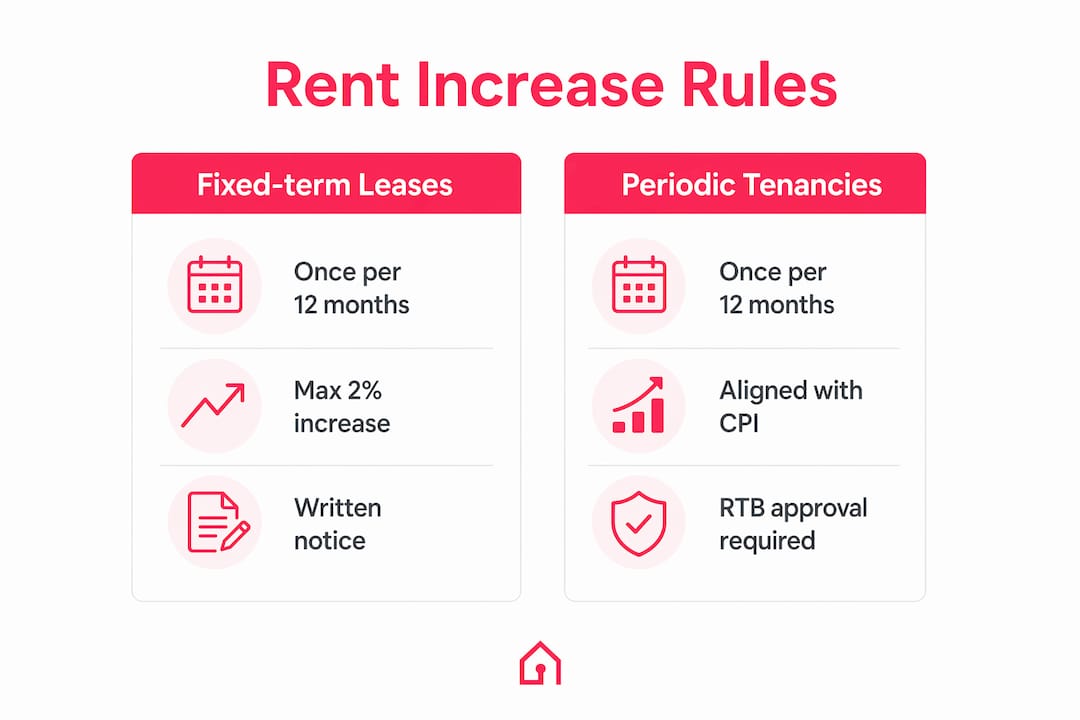
Rent regulation in Ireland is one of the most tightly controlled areas of the law. Landlords may only increase rent once every 12 months, and any increase is capped at either 2% or the rate of Consumer Price Index (CPI) inflation, whichever is lower. This cap prevents landlords from raising rents sharply in a single year, even in a rising market.
Rent can only be reset to market rate at two specific points: at the start of a brand-new tenancy, or after a six-year TMD cycle ends. This means a landlord cannot reset to market rent mid-tenancy simply because local prices have risen. That protection is significant for long-term tenants in high-demand areas like Dublin.
When a landlord does reset to market rent, the process is not simply a matter of naming a new figure. The steps they must follow are:
Identify the new market rent based on comparable properties in the same area.
Source three comparable rents from the RTB Rent Register to substantiate the proposed figure.
Serve a formal rent review notice on the tenant, including the comparable rents as evidence.
Allow the required notice period before the new rent takes effect.
If a landlord fails to provide the three comparable rents from the RTB Rent Register, tenants can challenge the increase through the RTB. A successful challenge can invalidate the proposed hike entirely. That is a meaningful protection, and one many tenants do not know they hold.
Scenario
Rule
Rent increase during tenancy
Maximum once per 12 months, capped at 2% or CPI (lower applies)
Market rent reset
Only at tenancy start or after a six-year TMD cycle
Evidence required
Three comparable rents from RTB Rent Register
New apartments (post-10 june 2025)
Special rules apply; check RTB guidance for your property type
Pro Tip:Check the RTB Rent Register before accepting any rent increase. If your landlord has not provided three comparable rents, you have grounds to dispute the review.
What are the grounds for ending a tenancy from march 2026?
Ending a tenancy in Ireland is a procedurally demanding process. From 1 march 2026, landlords must serve a Notice of Termination simultaneously to both the tenant and the RTB. Serving the tenant alone is no longer sufficient. A notice that does not reach the RTB at the same time is legally invalid.
The valid grounds for termination under the 2026 framework are:
Tenant breach: Non-payment of rent or serious anti-social behaviour, following a warning process.
Sale of the property: The landlord intends to sell within a defined period after the tenancy ends.
Owner or family use: The landlord or an immediate family member needs the property as their principal residence.
Substantial refurbishment: Works require vacant possession and cannot be carried out with the tenant in situ.
Change of use: The property is being converted to a non-residential use.
"Landlords must serve Notice of Termination simultaneously to the tenant and the RTB. Failure to comply invalidates the notice and risks penalties, including compensation orders against the landlord."
Electronic service of termination notices is permitted from 2026, but it carries real risk. Landlords must maintain verifiable proof of receipt if a tenant contests delivery. A contested electronic notice can force the entire process to restart, adding months of delay. Paper delivery with a signed acknowledgement remains the safer route for most landlords.
Do you need a written tenancy agreement in Ireland?
Written tenancy agreements are not legally mandatory in Ireland, but they are strongly recommended for both parties. Without a written contract, disputes about rent, deposits, and maintenance responsibilities become much harder to resolve. The RTB can still adjudicate without a written agreement, but the process is slower and less predictable.
A well-drafted tenancy agreement typically covers:
The agreed monthly rent and payment method.
The amount of the security deposit and the conditions for its return.
Maintenance responsibilities for both landlord and tenant.
Rules on subletting, pets, and alterations to the property.
Notice periods required by each party.
Landlords are legally required to register all tenancies with the RTB within one month of the tenancy start date. Failure to register can result in financial penalties. Registration also activates the RTB's dispute resolution service, which is the primary route for resolving disagreements about rent, deposits, or termination. You can read more about your rights in Hauzed's guide to tenancy agreements in Ireland.
Pro Tip:Ask your landlord for a written tenancy agreement before you move in. If they are reluctant, that is itself a warning sign. A written contract protects you at the RTB if a dispute arises later.
How have the 2026 reforms changed tenant protections and landlord obligations?
The 2026 reforms represent a clear shift in how Irish housing regulations balance the interests of tenants and landlords. The move from Part 4 to the six-year TMD gives tenants longer, more predictable security of tenure. For many renters, particularly those in Dublin, this means genuine stability for the first time in years. You can explore the full scope of these changes in Hauzed's 2026 tenant rights guide.
The compliance burden on landlords has increased considerably. The 2026 reforms demand careful procedural adherence at every stage, from rent reviews to termination notices. A single procedural error, such as failing to copy the RTB on a termination notice, can invalidate months of work and expose a landlord to compensation claims.
The distinction between small and large landlords now carries real legal weight. Large landlords face near-permanent occupancy restrictions that small landlords do not. This affects portfolio strategy, compliance planning, and the grounds available for ending a tenancy.
Area
Small landlords
Large landlords (4+ tenancies or companies)
Termination grounds
Broader, including owner/family use
Stricter, near-permanent occupancy rules
Compliance burden
Moderate, procedural care required
High, additional oversight and documentation
Rent review rules
Same cap applies to all
Same cap applies to all
RTB registration
Mandatory within one month
Mandatory within one month
Common pitfalls under the new regime include serving termination notices without simultaneous RTB notification, failing to provide comparable rents during a rent review, and missing the procedural steps required before terminating for rent arrears. Each of these errors can result in RTB sanctions or invalid proceedings.
Pro Tip:If you are a landlord, keep a compliance checklist for every tenancy action. The RTB publishes detailed procedural guides. Following them precisely is the best way to avoid costly mistakes.
Key takeaways
Irish landlord-tenant law in 2026 gives tenants a six-year minimum tenancy, capped annual rent increases, and strong procedural protections against unlawful eviction.
Point
Details
Six-year TMD from march 2026
New tenancies automatically renew every six years unless ended on statutory grounds.
Rent increase cap
Increases are limited to once per year, capped at 2% or CPI inflation, whichever is lower.
Simultaneous RTB notice
Landlords must serve termination notices to both the tenant and the RTB at the same time.
Written agreements recommended
Not legally required, but written contracts protect both parties during RTB disputes.
Landlord size matters
Large landlords face stricter termination rules and near-permanent occupancy restrictions.
Renting in Ireland: what the 2026 reforms really mean
The 2026 reforms are the most tenant-friendly changes Irish rental law has seen in a generation. The shift to a six-year TMD is not just a technical adjustment. It changes the lived experience of renting. A tenant who knows they cannot be removed without a statutory reason is a tenant who can actually settle into a home, invest in their community, and plan their life with some confidence.
That said, the reforms create real complexity for landlords, particularly smaller ones who manage properties alongside other work. The procedural requirements are not forgiving. A landlord who serves a termination notice correctly in every respect except simultaneous RTB notification will find the notice invalid. That is a harsh outcome for an honest mistake, and it is one the RTB takes seriously.
My view is that the law now rewards preparation. Tenants who understand their security of tenure rights, keep records of all communications, and act promptly at lease renewal time will be far better protected than those who assume their rights are automatic. Rights exist on paper. You have to exercise them.
For landlords, the message is equally clear. The days of informal rental management are over. Written agreements, RTB registration, documented rent reviews, and procedurally correct termination notices are not optional extras. They are the baseline. Landlords who treat compliance as a burden will find the RTB an expensive adversary. Those who treat it as a framework will find it manageable.
The rent control mechanism is imperfect, and the market pressures driving Dublin rents upward have not disappeared. But the combination of the TMD, the rent cap, and the RTB's dispute resolution service gives tenants a genuinely stronger position than they held five years ago. That is worth understanding, and worth using.
— Hauzed
Hauzed and safer renting in Ireland
Understanding your rights is the first step. Finding a verified, trustworthy rental is the next one.
Hauzed is a trust-first rental marketplace built for Ireland, starting with Dublin. Tenants can search verified rental properties, build a stronger profile, and connect with landlords through a platform designed to reduce scams and anonymous message chaos. Landlords and agencies can manage verified tenant interest, use AI matching with Hauzer, and handle conversations and visit scheduling in one place. Whether you are a tenant trying to stand out in a competitive market or a landlord managing compliance under the 2026 rules, Hauzed's rental platform gives both sides a clearer, safer process from the first search to the signed agreement.
FAQ
What is the Tenancy of Minimum Duration in Ireland?
The Tenancy of Minimum Duration (TMD) is a six-year minimum tenancy period introduced from 1 march 2026. New tenancies automatically renew at the end of each cycle unless the landlord ends the tenancy on one of the statutory grounds set out in law.
How often can a landlord increase rent in Ireland?
A landlord can increase rent once every 12 months. The increase is capped at 2% or the rate of CPI inflation, whichever is lower, and market rent resets are only permitted at the start of a new tenancy or after a six-year TMD cycle.
What happens if a landlord serves an invalid termination notice?
An invalid notice has no legal effect. The tenancy continues as if the notice was never served, and the landlord may face RTB sanctions or compensation orders. The most common cause of invalidity is failing to serve the notice simultaneously to both the tenant and the RTB.
Do I need a written tenancy agreement in Ireland?
A written tenancy agreement is not legally required, but it is strongly recommended. Written contracts clarify rent, deposit terms, and maintenance responsibilities, and they make RTB dispute resolution significantly more straightforward for both parties.
How do I dispute a rent increase with the RTB?
If your landlord has not provided three comparable rents from the RTB Rent Register to support a market rent reset, you can refer the matter to the RTB for adjudication. A successful dispute can invalidate the proposed increase entirely.