How to Get Your Essential PPS Number in Ireland (2025 Guide)
30 August 2025
8.1 min read
A complete 2025 guide to getting a PPS number in Ireland: who needs it, required documents, step-by-step application, timelines and common FAQs.
How to Get Your Essential PPS Number in Ireland (2025 Guide)
A Personal Public Service (PPS) Number is your key to working, studying, and accessing public services in Ireland. It’s a unique identifier (seven digits plus a letter or two) issued by the Department of Social Protection.
Think of it as the Irish equivalent of a Social Security Number (USA) or PAN/CPF (India) – a gateway to employment, taxes, healthcare, education, and more.
Once you have it, it stays with you for life. In this friendly, step-by-step guide we’ll cover everything international students and workers (especially those from Spain, Brazil, India and elsewhere) need to know to get a PPS number in 2025: why you need it, how to apply, what documents to gather, and useful tips to make it smooth.
What Is a PPS Number and Why Do You Need It?
A PPS number is a unique reference that identifies you to Irish government agencies. It’s used for virtually all official purposes – from paying taxes and getting a paycheck to applying for a driver’s licence, opening a bank account, or accessing healthcare.
For example, you need a PPS number to register with Revenue when you start a job, to apply for social welfare benefits or a medical card, or to enroll in college
In short, any time you deal with state bodies (Social Welfare, Revenue, Education, etc.), your PPS number is required.
Without it, your employer cannot legally pay you (they need it for tax registration), banks may refuse to open a salary account, and you can’t claim student grants, welfare payments or other benefits.
Who needs a PPS number?
In practice, almost anyone who lives, works, or studies in Ireland for more than a few weeks will need a PPS number. Typical examples include:
Employees and interns. If you take up employment, even a part-time student job, your employer must have your PPS number for payroll and tax purposes
Self-employed or contractors. You’ll need a PPS to register for self-employment or VAT with Revenue.
Students enrolling in college/university. Especially if your course is longer than three months or involves a grant/loan, you’ll need a PPS.
Healthcare users. To register with a GP, get a medical card, or access public health schemes, you need a PPS.
Drivers. To get an Irish driving licence or learner permit, you need a PPS.
Related Topics
#pps-number#documentation#ireland#expat
Related Articles
Family benefits. To apply for child benefit, social welfare payments, or certain training courses (like SafePass), a PPS is required.
Education. To register at school/college, get student grants or student visas, you often need a PPS.
If you’re visiting for a short stay (under ~3 months) with no work/study commitments, you might not strictly need a PPS.
However, many international students (even on short exchange programs) find that banks, colleges or part-time jobs ask for it, so it’s usually safer to apply anyway if you plan to stay more than a few weeks. So, you need a PPS number if you plan to:
Work legally in Ireland (your employer cannot pay you without it).
Register for tax with the Revenue.
Access public healthcare or medical cards.
Enroll in college or university.
Apply for a driver’s licence or learner permit.
Receive social welfare payments or child benefits. Even if you’re only staying in Ireland for a few months for work or study, you’ll still need a PPS number.
In summary: if you live here and do anything official – work, study, rent, or get any government service – get a PPS number.
How to Apply for a PPS Number (Step-by-Step)
Ireland’s official process is now fully online, so there’s no need to queue in person unless you really can’t apply digitally. Here’s how it works:
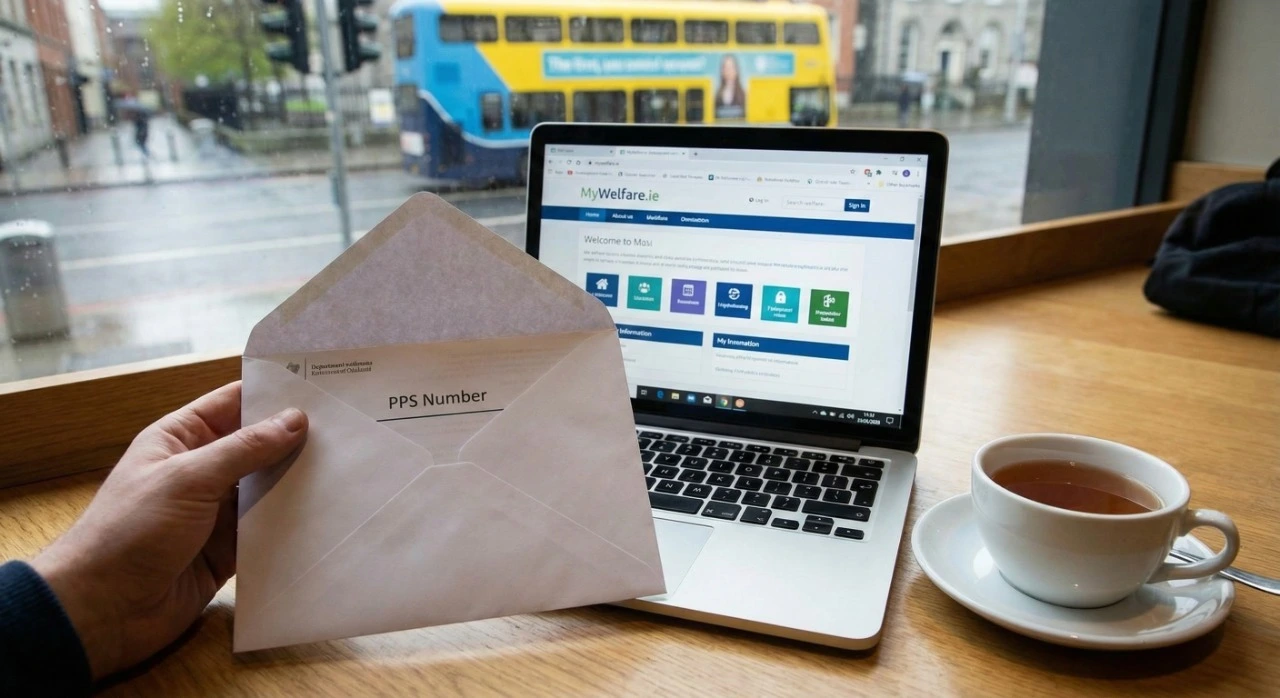
Get a MyGovID account. This is Ireland’s secure government login system. You need at least a Basic MyGovID account to use MyWelfare.ie. Go to mygovid.ie to register (it’s free and usually just takes a few minutes).
Visit MyWelfare.ie and start the PPS application. Log in at MyWelfare.ie with your MyGovID. Select “Apply for a PPS number” from the menu. This service is available to anyone in Ireland (or even abroad, if dealing with Irish government matters). You’ll be prompted to enter your personal details (full name, date of birth, nationality, etc.).
Upload your documents. You will need to upload scanned copies or photos of the required documents (see next section for details). These include:
A photo ID (passport, national ID or driving licence – see below).
Proof of address in Ireland (recent utility bill, bank statement, tenancy agreement, or similar).
Reason for applying (for example, a job offer letter, college acceptance, or other official letter stating why you need the PPS).
Submit and attend any follow-up. After you submit the application, you may receive an in-person appointment or ID check at your nearest Intreo (Social Welfare) office. This is to verify the originals of your documents. (Not everyone gets an appointment – it depends on your case.) In any case, your application will then be processed by DSP staff.
Get your PPS by mail. If all is in order, the Department will send your PPS number by post to your Irish address. This usually arrives within 5–10 working days of approval. (Delays can happen if documents are unclear or during busy periods.) Keep an eye on your mailbox – once the letter arrives, it will contain your PPS number.
Example (International student): Ana from Spain registers at mygovid.ie and logs into MyWelfare. She fills in her details, uploads a photo of her Spanish DNI (EU ID card) and a recent utility bill from her Dublin apartment, plus her college admission letter as the “reason”.
She submits online, attends the brief appointment, and two weeks later her PPS number arrives by post.
What Documents Do I Need to Get a PPS Number? To apply for a PPS number, you’ll need:
The application requires three categories of documents. Gather these before you start:
Proof of Identity. This depends on your citizenship:
EU/EEA citizens (e.g. Spain, Germany, Poland): A current passport or national identity card is acceptable. For example, a Spanish DNI or Portuguese citizen card works fine.
Non-EU/EEA citizens (e.g. Brazil, India, UK/US): You will need a valid passport. If you already have an Irish residence permit or visa, bring that too (it can help verify your status, though it’s not always required if you’re applying for the first time in Ireland).
Proof of Address in Ireland. You must show a document (dated within the last 3 months) that clearly shows your name and address in Ireland. Suitable documents include:
Utility bill (electricity, gas, internet, etc.).
Bank statement or official letter from your bank.
Tenancy agreement or an official rent receipt from your landlord.
Government letter (e.g. tax or social welfare letter) addressed to you.
Letter from your employer or college confirming your Irish address.
If you’re staying with friends/family, you can submit a utility bill in their name plus a signed note from them saying you live at that address.
Be careful: the address proof must not be older than 3 months, and it must match your name. If you just moved in and don’t have a bill yet, ask your landlord or flatmate to write a signed cover letter (or fill out the third-party confirmation form) confirming you live there – this can substitute for a bill.
A job offer letter from an Irish employer (showing you will be working in Ireland).
A college/school acceptance or enrollment letter (if you’re a student).
An official letter from Revenue or Social Welfare (if you’re registering for taxes or benefits).
In some cases, a letter from a doctor or hospital (if you need a PPS for health services), or a driving school (for a licence) can work.
Basically, any formal document that explains why you need to interact with the Irish state will do. For instance, if you got a postgrad place at Trinity, you can use your admission email; if you have a job, use the contract or offer; if you plan to pay taxes, you might use a letter from Revenue or your employer. (If in doubt, any one of these is usually enough. Just be clear about your purpose.)
Gather your documents now – you’ll upload them to MyWelfare. PDF scans or high-quality photos on your phone are fine (keep files under the size limit). Double-check that names and dates are clearly visible to avoid delays.
After You Apply for the PPS Number: Timeline and Follow-Up
Once your application is submitted and your in-person check (if any) is done, processing is fairly quick. Typically, you will receive your PPS number by post within about 1–4 weeks.
Some guides report 5–10 working days in normal times. However, processing can take longer if:
The office needs to verify any details (for example, confirming your job or study).
Your documents were incomplete or the images were unclear.
It’s a very busy period (e.g. start of academic term).
You applied remotely and your case is more complex.
In practice, most people get their PPS in 1–3 weeks. If you find your payroll using emergency tax (see below), it usually means they’re waiting for your PPS. Patience is key, but if it’s taking more than a month, you can contact your local Intreo/Social Welfare office to check on the status.
In-Person vs Online Application of PPS Number
For 2025, the recommended method is online via MyWelfare. The government has shifted nearly all PPS applications to the web. That said, there are still options if you cannot apply online (e.g. no internet or no address yet):
Online (preferred): Use MyWelfare with your MyGovID. It’s fast and you can do it from anywhere.
By post (rare): If you truly cannot apply online, you can download and mail the official REG1 application form. This is the old manual form. You would send it (with photocopies of your documents) to the DSP address in Leitrim. (This is rarely needed nowadays.)
In person: Usually not needed, but if you have special circumstances (no phone, no ID card, etc.) you can phone or visit your local Intreo or PPS Allocation Centre. During Covid, many offices closed PPS walk-ins, but you can still request an appointment through your local branch if necessary.
In short: Do the online route unless you really can’t. It’s free and official. And remember, the online process itself might schedule a brief appointment with a DSP officer to see your original documents – but you start everything on MyWelfare.
Cost and Scams
Good news: It’s completely free to apply for a PPS number through the official channels. Never pay anyone or any website for this service. Use only the government’s websites (mygovid.ie, mywelfare.ie, or gov.ie).
There are some unscrupulous agencies or copycat sites out there that might charge a fee – ignore them. If you see a website or ad saying “get your PPS number fast for €X,” it’s a scam. The DSP provides the PPS service free of charge.
What If I Don’t Have a Job Yet in Ireland?
You might worry: “I don’t have a job offer yet – can I still apply?” The answer is yes, as long as you have another valid reason. Your application must always state a reason, but that reason doesn’t have to be employment. For example, acceptable alternatives include:
Student status: Use your college acceptance letter or proof of enrollment. Nearly every university issue letter for this purpose.
Training or volunteering: Perhaps a letter from an Irish organization saying you’ll train or volunteer.
Property or rental: A landlord’s signed letter stating you live at their address (to pay tax on property, etc.).
Self-employment: A letter of intent from a client, or a Revenue self-assessment request, etc.
Other official needs: Sometimes people use a doctor’s letter or a government letter as “reason” if they have none of the above.
The key is to give any credible “business case” for needing the PPS. The Department will reject requests that say “just because” or “planning to look for work”. But if you’re studying or have any concrete plan, that will suffice. In fact, applying as a student is very common – as one guide notes, “It’s needed for tax purposes, part-time jobs, internships, or work placements during your studies”.
Living in Dublin (or Any City): Where to Apply
It doesn’t matter if you live in Dublin, Cork, Galway or a small town – the process is the same online.
Just make sure all your forms and documents show your correct Irish address (Dublin or elsewhere). There used to be PPS Number Allocation Centres in each region, but since Covid the move has been toward MyWelfare.
You still submit any appointment checks at a local Intreo centre. But start online, and use your local office only if you run into issues.
Lost Your PPS Number?
If you already had a PPS number (for example, you lived or worked here years ago), you do not need to apply again. Just retrieve the old number. Common ways to find it:
Check old payslips or tax documents (P45, P60 forms) – your PPS will be printed there.
Look at any old letter from DSP or Revenue – it should have your PPS.
If you have a Public Services Card, medical card, or GP visit card, the PPS is on those.
If all else fails, you can contact the Client Identity Services (CIS) or your nearest Intreo/Social Welfare office – they can look it up for you if you give your name, date of birth and address.
If you can’t find it and need official proof, you can request a “Statement of Your PPS Number” on MyWelfare (log in and choose that service). This will send you a letter stating your PPS number.
Frequently Asked Questions about PPS Number
Can I start working without a PPS? Technically, you can begin work, but your employer will apply the “emergency tax” rate on your pay until you provide a PPS Numbner. In other words, you’ll overpay tax at first (roughly 40% instead of ~20%) until your PPS arrives.
Once you give your PPS to the employer, they will adjust your payroll and you’ll receive a refund in your next pay run. So it’s best to apply for the PPS immediately when you land in Ireland, even if you haven’t started the job yet.
How do I know when my PPS is active? Your PPS number never expires. Once issued to you, it remains valid for life (even if you leave and return to Ireland later).
There’s no separate activation – as soon as you receive the letter, it’s ready to use.
Can I use my PPS for tax purposes? Yes – in fact, registering for tax (PAYE or self-employment) with Revenue requires your PPS number. Every time you pay income tax in Ireland, it’s filed against your PPS.
Conversely, the tax office will send refunds, credits and correspondence linked to your PPS.
Is my PPS valid indefinitely? Yes, you keep the same number permanently. (Only your physical PPS card used to have an expiry; the number itself is permanent.)
You can even return to Ireland years later and pick up where you left off with the same PPS number.
Can I get a PPS before moving to Ireland? No. You must be in Ireland with a local address to complete the process and receive the letter.
The postal letter with your PPS will be sent to an Irish address only. (There are a few exceptions – for example, if you already have an Irish address but are temporarily abroad, you could start online – but in general, wait until you have set up residency in Ireland.)
Can a non-Irish bank account receive my salary? Yes, if it’s a euro account in the EU or EEA. Under EU SEPA rules, Irish employers must accept any European IBAN for salary payments.
For instance, a Spanish or German bank IBAN (starting with ES, DE, etc.) is perfectly fine for getting paid from Ireland.
They cannot force you to open an Irish bank account. (Note: IBANs from outside the SEPA area, or in non-euro currency, are not typically used; most expats open at least a euro account with a European bank.)
Why was I charged emergency tax? As above, emergency tax is applied when your employer doesn’t have your PPS on file yet. It’s just a temporary measure.
When you receive your PPS and give it to payroll, they’ll correct your tax code. Any overpaid tax will be refunded automatically in your salary (or you can claim it via Revenue’s myAccount portal if needed).
How do I claim a tax refund? If you’ve overpaid tax (often due to emergency tax or being on the wrong tax credit), you can use Revenue’s online myAccount system to claim a refund. Log into Revenue.ie and complete a simple Income Tax Return or refund application.
The process is straightforward, and any refund will be paid into your bank account once processed.
Important Tips to get the PPS Number
Apply early: Don’t wait until your first day of work or college to apply. Start the PPS process as soon as you have an address and documents. This ensures you can give your PPS to your employer on time (avoiding weeks of emergency tax), and you can open bank accounts or get GP appointments without delay.
Get a landlord’s letter if renting: If you rent a room or flat and bills are in your landlord’s name, ask them to write a quick letter confirming that you live there. Attach it to the utility bill as proof of address. This is a common trick that satisfies the requirements.
Use official websites only: The only official PPS application site is MyWelfare.ie. Anything else (e.g. private “PPS service” sites) is a scam. Remember, it’s free – the government won’t ask you for money.
Keep documents updated: Proof-of-address documents must be recent (<3 months old). Always double-check that your name and address match exactly on every page.
Use your MyGovID: This one login grants you access not only to MyWelfare but also to many other government services (tax, social welfare, education schemes). It’s handy to set it up right away even beyond just the PPS.
Contact info: If you run into problems, you can email CIS@welfare.ie or call the Client Identity Services at +353 71 967 2616 (or 0818 927 999 in Ireland). For general PPS help, your local Intreo/Social Welfare office can guide you too.
Getting your PPS number is an essential first step to life in Ireland. With it in hand, you can open a bank account, get paid legally, access healthcare, and start enjoying everything Ireland has to offer.
Just follow the steps above, keep your documentation in order, and use the official channels.
You’ll have that PPS number soon and be well on your way to settling in Ireland!
Additional PPS-Related FAQs (2025 Updates)
🏠 How do I change or update my PPS address?
You can update your PPS address online at MyWelfare.ie or by visiting your local Intreo Centre.
Make sure to bring valid proof of your new address (like a recent bill or tenancy agreement). For More information related to the PPS Number you can see the following video: https://youtu.be/s8qA0nK-B1Y?si=gSFby_wsUiXA_IBf
💸 Why am I paying emergency tax?
You might be paying emergency tax because your employer hasn’t linked your PPS number with Revenue.ie yet.
Once your PPS number is registered properly, you’ll receive a refund automatically through payroll.
💰 How do I get a tax refund in Ireland?
If you’ve overpaid tax — often due to starting a new job without a PPS number — log in to your Revenue myAccount portal and request a tax refund.
Refunds usually take a few days to process once your details are verified.